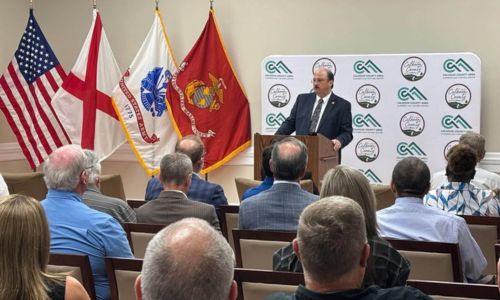
Anniston, AL — Alabama State Sen. Keith Kelley met with constituents Thursday, July 23, at the Calhoun County Chamber and Visitors Center to discuss the 2026 legislative session, highlighting the state’s record-setting budgets, public safety initiatives, education funding and legislation affecting veterans, crime victims and government accountability.
Kelley described the session as one of the busiest in recent state history, noting that lawmakers considered 1,046 bills — including 666 House bills and 380 Senate bills — with 402 measures ultimately passing both chambers.
Serving on both legislative budget committees, Kelley devoted much of the presentation to Alabama’s FY2027 budgets.
The approximately $10.5 billion Education Trust Fund includes funding for K-12 schools, higher education, community colleges, employee health insurance, transportation, reading initiatives, career technical education and First Class Pre-K programs. Kelley noted the budget also provides a 2% pay raise for K-12 education employees and two-year college employees while continuing support for the CHOOSE Act education savings account program. Additional one-time funding was appropriated for technology upgrades, capital improvements, deferred maintenance and other infrastructure projects at educational institutions.
Kelley said the Education Trust Fund represents the largest education budget in Alabama history and reflects continued investment in students, teachers and workforce development while maintaining conservative budgeting practices.
He also outlined the state’s approximately $3.7 billion General Fund budget, which provides funding for Medicaid, corrections, mental health services, the Department of Human Resources, law enforcement, the judicial system, veterans programs and other core government services.
According to Kelley, the Legislature prioritized funding recurring expenses with recurring revenue while maintaining reserve funds and avoiding deficit spending.
Other budget priorities included continued reductions to Alabama’s state grocery tax, additional investments in school safety, workforce development, prison operations, mental health services and technology improvements for schools and colleges.
Public safety legislation was another major focus of the presentation.
Kelley discussed legislation allowing prosecutors to seek the death penalty in certain cases involving the rape, sodomy or sexual torture of children younger than 12. He also reviewed laws increasing penalties for attempting to elude law enforcement, shooting into occupied school buses or school buildings, and reckless endangerment involving multiple victims. Additional legislation extended the filing deadline for crime victim compensation claims from one year to two years.
He also highlighted “Trey’s Law,” which prohibits the use of nondisclosure agreements to prevent survivors of sexual abuse from speaking publicly about their abuse.
Among the bills Kelley sponsored this session was Senate Bill 199, which expands supervision tools available to parole and probation officers overseeing certain registered sex offenders convicted of crimes involving children. The legislation authorizes mandatory treatment and periodic polygraph examinations while allowing restrictions on internet-capable electronic devices and post office boxes under specified circumstances.
Kelley also highlighted several other bills he sponsored, including Senate Bill 41, which prohibits individuals convicted of elder abuse, exploitation or certain related crimes from inheriting from their victims, and Senate Bill 104, requiring governance training for members serving on state boards subject to sunset review.
Additional measures sponsored by Kelley continued several state licensing boards, restructured the Alabama Construction Recruitment Institute under the Department of Workforce, and required displays of the Ten Commandments in certain public school classrooms and common areas when funded through private donations and accompanied by historical context.
The presentation also included legislation designed to assist disabled veterans purchasing homes, create an alternative pathway for veterans to become classroom teachers, strengthen protections against title fraud and implement broad reforms to the Alabama Public Service Commission, including expanded oversight authority and changes to utility regulation.
Kelley said the legislation approved during the 2026 session reflects continued efforts to invest in education, strengthen public safety, support veterans, improve government accountability and maintain Alabama’s conservative fiscal approach while preparing the state for future growth.