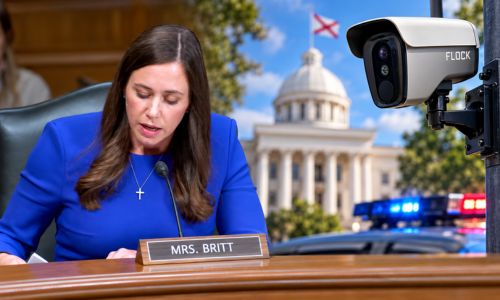

WASHINGTON, D.C. — U.S. Senators Katie Britt, R-AL, and Raphael Warnock, D-GA, are calling on the U.S. Department of Justice to develop guidance for state and local law enforcement agencies on the use of automatic license plate reader technology, citing both its value in criminal investigations and concerns about privacy and potential misuse.
In a Sept. 22 letter to Attorney General Todd Blanche, the senators asked the DOJ to provide guidance aimed at preventing unauthorized access and abuse of automatic license plate reader systems, commonly known as ALPRs. The request specifically referenced systems such as those operated by Flock Safety. Britt’s office publicly announced the letter Sept. 23.

ALPR systems generally use cameras to capture information about passing vehicles, including license plates and characteristics such as make, model and color. Law enforcement agencies use the technology for purposes that include identifying stolen vehicles, locating missing or endangered people and developing leads in criminal investigations.
At the same time, the technology’s ability to collect and share vehicle-location information has prompted questions about access, oversight and privacy.

“We are deeply concerned about the misuse of ALPR systems and believe that appropriate safeguards are necessary to protect against unauthorized access and abuse, including by individuals who might misuse the technology to stalk and harass their victims,” Britt and Warnock wrote. The senators also asked that federal funding for the technology be accompanied by appropriate oversight.
Britt said she believes the cameras can provide law enforcement with useful investigative tools while additional safeguards could reduce the risk of misuse.
“Flock cameras have proven to be a valuable tool for law enforcement in keeping our communities safe,” Britt said. “While I support the technology’s aim, I also believe commonsense safeguards can prevent misuse by a small number of bad actors.”
The issue was also examined during a Sept. 23 hearing of the Senate Judiciary Subcommittee on Crime and Counterterrorism titled “Always Watching: Flock’s Nationwide AI Surveillance Network.” Witnesses included law enforcement, privacy and civil-liberties representatives, a cybersecurity engineer and a driver who said she had been wrongfully accused.
During the hearing, Britt said law enforcement’s need for investigative tools should be weighed alongside constitutional privacy protections.
“I think two things can be true at the same time,” Britt said, adding that law enforcement should have the resources necessary to protect the public while Fourth Amendment rights must also be protected.
Britt pointed to cases in Alabama in which ALPR technology has been used to help locate missing children, endangered people and an older adult with dementia. She also acknowledged reports of misuse involving the technology and questioned Pinal County, Arizona, Sheriff Ross Teeple about appropriate uses and potential safeguards.
Teeple told senators about a case in which an automatic license plate reader helped authorities identify a driver accused of forcing another vehicle into oncoming traffic in a fatal incident. He also discussed law-enforcement recommendations that ALPR systems collect still images of license plates rather than continuously livestreaming or recording video.
Privacy concerns were raised by other participants in the hearing as well. Senate Judiciary Committee Ranking Member Dick Durbin, D-IL, said lawmakers need to balance public safety with privacy and called for oversight and accountability surrounding the technology. Concerns discussed during the hearing included access to collected data, sharing information across jurisdictions and the potential use of ALPR information to track or stalk individuals.
Britt said the technology should not be used to harass or improperly track people and called for clearer standards governing its use.
The bipartisan letter from Britt and Warnock does not call for eliminating ALPR systems. Instead, the senators are asking the Justice Department to establish guidance and oversight intended to preserve legitimate law-enforcement uses while reducing opportunities for unauthorized access or abuse.