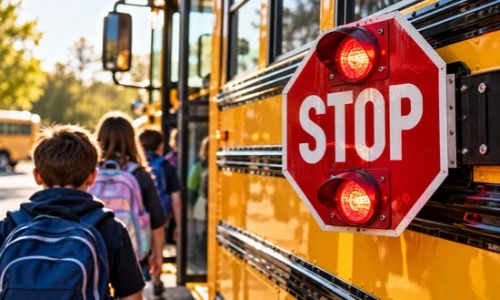

MONTGOMERY, AL — The Alabama Law Enforcement Agency (ALEA) is reminding motorists, parents and students of the importance of school bus safety as Alabama observes National School Bus Safety Week, October 19–23, 2026.
The annual observance, recognized during the third full week of October, focuses on safe driving practices, student awareness and the role of school bus drivers in transporting children safely. This year’s theme, “Safe Rides, Everyday Heroes,” highlights the shared responsibility of protecting students traveling to and from school.

According to data provided to ALEA by the University of Alabama’s Center for Advanced Public Safety (CAPS), Alabama recorded 589 school bus-related crashes in 2025, resulting in two fatalities. So far in 2026, the state has reported 411 school bus-related crashes with no fatalities.
Of those statewide totals, ALEA Troopers investigated 138 school bus-related crashes in 2025 and 81 crashes in 2026.

ALEA Secretary Hal Taylor emphasized the importance of motorists remaining attentive around school buses and school zones.
“Every child deserves a safe trip to school and back home, and that responsibility extends far beyond the school bus driver,” Taylor said. “It includes parents, students and motorists, making safety a priority.”
Taylor encouraged drivers to reduce their speed, avoid distractions and exercise patience near school bus stops.
ALEA Department of Public Safety Director Col. Jeremy Burkett also stressed that school bus safety requires year-round attention.
“School bus safety is not just a concern during one week of the year. It is a responsibility every time we get behind the wheel,” Burkett said.
He reminded motorists that passing a school bus displaying flashing red lights and an extended stop arm is prohibited under applicable Alabama law.
Alabama School Bus Stopping Laws
ALEA is reminding drivers of Alabama’s requirements when approaching stopped school buses.
On roadways with fewer than four lanes, motorists traveling in both directions must stop when a school bus displays its stop signal.
On roadways with four or more lanes, motorists traveling in the same direction as the school bus are required to stop. Drivers must remain stopped until the bus withdraws its stop signal and it is safe to proceed.
A first conviction for unlawfully passing a stopped school bus carries a fine ranging from $150 to $300. Subsequent convictions can result in higher fines and additional penalties.
Motorists should also slow down and prepare to stop when a school bus activates its flashing yellow warning lights.
Safety Recommendations for Students and Parents
The National Highway Traffic Safety Administration (NHTSA) recommends several precautions to reduce the risk of injuries around school buses.
Students should arrive at their designated bus stops at least five minutes before the scheduled pickup time and wait in a safe location away from traffic.
Children should remain clear of the roadway until the bus has stopped completely, its doors have opened and the driver has indicated that boarding is safe.
When entering or exiting the bus, students are encouraged to use handrails and avoid rushing.
NHTSA also recommends that children never walk behind a school bus. When crossing in front of a bus, students should remain at least 10 feet away, establish eye contact with the driver and wait for a signal before crossing.
Students should avoid distractions such as cellphones and headphones while approaching or leaving bus stops.
Officials Emphasize Year-Round Awareness
Although National School Bus Safety Week is observed annually in October, ALEA officials emphasize that safe driving practices are necessary throughout the school year.
The agency encourages drivers to remain alert during morning and afternoon transportation hours, particularly in school zones, residential neighborhoods and areas where children regularly board or exit buses.
ALEA officials say cooperation among motorists, school transportation personnel, parents and students is essential to reducing crashes and protecting children on Alabama roadways.