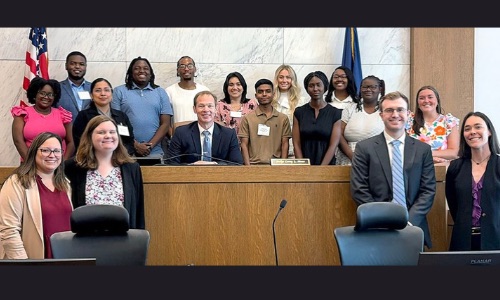

JACKSONVILLE, AL — As originally reported by Brett Buckner with JSU’s media department, eleven Jacksonville State University students recently completed the Leadership, Education and Development (LEAD) Program, an initiative designed to connect college students with local businesses, community organizations and professional opportunities throughout Calhoun County.
The program, developed through a partnership between Jacksonville State University and the Calhoun County Area Chamber & Visitors Center, provides students with hands-on experiences in leadership development, civic engagement, career readiness and community awareness.

Launched three years ago, LEAD was established to address a gap in leadership development opportunities specifically designed for college students. Savannah Dempsey, business development director for the Chamber and LEAD program director, said the initiative aims to introduce students to career opportunities in the region before they make decisions about where to work after graduation.
“We wanted to create something specifically for that age group,” Dempsey said, “and give them an opportunity to get connected to the business and community side of Calhoun County while they are still in college.”

Dempsey explained that the program also seeks to encourage students to consider remaining in the area after completing their degrees.
“We felt like we were missing an opportunity to reach these students before they had already made up their minds about where they wanted to go after college,” she said. “We wanted to introduce them to the people, businesses and opportunities in their own community and show them that they can build a career and find their dream job right here in Calhoun County.”
Throughout the program, students visited businesses, interacted with local leaders and participated in activities addressing economic development, community needs and professional growth. Participants represented a range of academic disciplines, including engineering, nursing, public health, business, education and criminal justice.
Among the participating students was Vintavious (VJ) Billingsley, an applied manufacturing engineering major, who said the experience strengthened his understanding of effective leadership.
“I learned about important qualities such as the ability to continue to learn, overcoming adversity, and the importance of building a strong team,” Billingsley said. “While learning these things, I also learned about the tools and opportunities that can help me grow professionally and become one of Alabama’s next generation of leaders.”
Greesh Sah, an applied manufacturing engineering major concentrating in automation and robotics, said the program introduced him to employment opportunities he had not previously considered.
“Participating in the LEAD program showed me how many great career and industry opportunities exist right here in Calhoun County,” Sah said. “Hearing directly from representatives at the Chamber of Commerce, Regions Bank, First Bank of Alabama, and the Anniston Army Depot opened my eyes to our local job market.”
Sah also credited his mentor, Laurel Harp, with encouraging him to consider a long-term career in the region.
Professional development activities included a LinkedIn workshop and a Dominance, Influence, Steadiness, and Conscientiousness (DiSC) assessment, which helped participants better understand communication styles and workplace interactions.
“The workshops and sessions helped me build practical skills in leadership, team communication, and professional development,” Sah said. “The Dominance, Influence, Steadiness, and Conscientiousness (DiSC) assessment showed me that everyone has different strengths and taught me how to communicate better across diverse personalities.”
Another component of the program was an Asset Limited, Income Constrained, Employed (ALICE) simulation conducted in partnership with United Way of East Central Alabama. The activity provided participants with an opportunity to experience scenarios reflecting the financial challenges faced by working individuals and families with limited resources.
The simulation also encouraged students to examine how economic conditions, access to services and community resources can affect residents’ health and well-being.
For Paige Glaspie, a Master of Public Health student, and Joy Lawrence, a nursing student, the program provided exposure to issues that may influence their future work in healthcare and public health.
Dr. Kelley Swatzell, associate professor and director of the Master of Public Health Program, said the experiences can help students better understand the communities they will serve.
“Programs like LEAD help students understand the communities they serve and strengthen their ability to work collaboratively across sectors,” Swatzell said. “These experiences prepare future healthcare and public health professionals to lead effectively, build partnerships, and address the complex challenges that impact community well-being.”
Participants also gained exposure to the federal judicial system through a visit to the federal courthouse. During the visit, students participated in a courtroom simulation involving U.S. District Judge Corey L. Maze.
Sah described the experience as one of the program’s most memorable activities.
“We took part in an accident court case simulation inside a real courtroom, which helped me understand how legal procedures work,” Sah said. “We also met U.S. Marshals and saw the holding cells, giving us a firsthand look at the federal justice system.”
In addition to individual development activities, students completed team projects focused on promoting Calhoun County and identifying ways to encourage students and young professionals to establish careers in the region.
Dr. Dana Ingalsbe, professor in the Department of Applied Engineering, said the program provides opportunities for students to develop professional connections while gaining an understanding of how their academic skills can contribute to local organizations.
“Through the program, students gain valuable exposure to businesses, agencies, and organizations across the region while building new connections with peers from a variety of academic disciplines,” Ingalsbe said. “I am confident that every student who participated in LEAD left with a greater appreciation for how they can make meaningful contributions in their future careers.”
Sah said one of his primary takeaways was recognizing the importance of interpersonal skills alongside technical knowledge.
“As an engineering student,” he said, “the biggest lesson I took away is that technical skills are important, but learning how to communicate, collaborate, and support the people around you is what creates lasting impact.”
Dempsey said the program’s broader purpose extends beyond employment opportunities to helping students become engaged members of the community.
“We’re also hoping they gain confidence, leadership skills and a better understanding of how they can make an impact locally,” Dempsey said. “It’s not just about finding a job here. It’s about helping them see that they can be a part of the community, build relationships and make a difference.”
Jacksonville State University LEAD Program Participants
The 11 students who completed the program and their respective academic programs are:
- Akeriyah Powell – Applied Manufacturing Engineering
- Delaney Whiddon – Marketing
- Greesh Sah – Applied Manufacturing Engineering, Automation and Robotics
- Isaac Brown – Economics, with a minor in Finance
- Joy Lawrence – Nursing
- Kailyn Minnifield – Early Childhood/Elementary Education
- Paige Glaspie – Master of Public Health, Generalist
- RaShaud Drake – Bachelor of Arts in Integrated Studies, with a concentration in Public Relations
- Teresa E. Alvarado – Criminal Justice/Criminology
- Tytianna McDonald – Biology
- Vintavious (VJ) Billingsley – Applied Manufacturing Engineering
Through its partnership with Jacksonville State University, the Calhoun County Area Chamber & Visitors Center continues to use the LEAD Program to introduce students to regional industries, community organizations and professional networks while encouraging leadership development and local engagement.