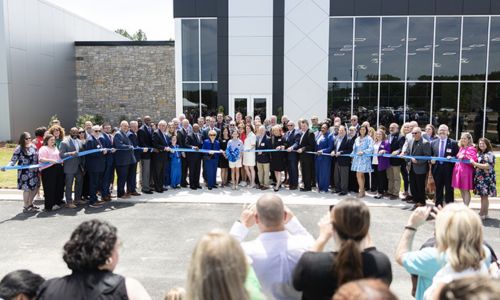

Rainbow City, AL – Jacksonville State University, alongside regional leaders, educators, and community partners, officially celebrated the grand opening of the Jacksonville State University STEAM Institute – Home of Challenger Learning Center of Northeast Alabama in Rainbow City.
The new facility is the first Challenger Learning Center in Alabama and is designed to provide hands-on STEAM education opportunities for students throughout Northeast Alabama. The center will focus on immersive, space-themed learning experiences aimed at encouraging curiosity, teamwork, and career exploration among students in grades 5 through 8.

Dr. Farrah Hayes, executive director of the Challenger Learning Center of Northeast Alabama, described the opening as the result of years of planning and dedication from supporters across the region.
“Today has been years in the making, with people who started this long before I came along,” Hayes said. “The dedication here reflects the commitment of those who believed this day would come. Today, we open these doors, but more importantly, we open possibilities for every student who walks through them.”
Tony Smith, chairman of the Challenger Learning Center of Northeast Alabama Board, said the center represents more than a new building for the community.
“This building is not the destination—it is the launch pad,” Smith said. “Today, we celebrate more than the opening of a building. We celebrate the launch of curiosity, exploration, and discovery for generations of students who will walk through those doors.”
The center’s programming will include simulated space missions and collaborative activities that connect classroom instruction with real-world applications in science, technology, engineering, arts, and mathematics.
Jacksonville State University President Dr. Don C. Killingsworth Jr. said the partnership reflects the university’s long-term commitment to educational access and student success.
“Today is about opportunity,” Killingsworth said. “It is about what becomes possible when a student walks through these doors and begins to see something bigger for themselves.”
Killingsworth added that the center aligns with the university’s mission to create educational pathways for students across the region.
“At Jax State, we believe our role is to help open those doors—not just for the students already on our campus, but for the students who will one day be there,” he said.
Dr. Eric Mackey, Alabama’s State Superintendent of Education, highlighted the importance of local leadership and partnerships in expanding educational opportunities.
“What you are doing here today is creating the future that these young people will live in,” Mackey said. “It is leadership at the local level that makes opportunities like this possible.”
Dr. June Scobee Rogers, founding chair of Challenger Center and widow of Space Shuttle Challenger Commander Dick Scobee, spoke about the long-term impact the center can have on students.
“It’s more than a building. It’s opportunity. It’s an awakening for students to know, to have the background, the knowledge, the experience,” Rogers said. “So, when students take part in the Challenger Learning Center, they see themselves as something other than a student. They see themselves on a trajectory toward a career that they might be interested in.”
Barry Moore emphasized the role educational initiatives like the center play in workforce development and preparing future generations.
“It’s these kinds of learning opportunities—these kinds of events—that make our workforce development lead the way in the nation,” Moore said. “And as we train our students, those future generations, we are preparing them for the opportunities ahead.”
Joe Taylor said the project represents an important investment in local students and their future success.
“We know how important this is,” Taylor said. “How important it is to pipeline our kids in the appropriate direction and send them on a trajectory of success.”
Through the Jax State STEAM Institute, the university will continue supporting the Challenger Learning Center through faculty involvement, educational partnerships, and student engagement initiatives designed to expand STEAM opportunities throughout Northeast Alabama.
As leaders gathered for the ribbon-cutting ceremony, many emphasized that the lasting impact of the center will ultimately be measured by the students it inspires and the opportunities it creates for future generations.