

Jacksonville, AL – On Friday, January 30, 2026, Jacksonville State University held its first graduation ceremony for the newly established Southeastern Leadership Command College (SLCC). The program was developed by JSU to help law enforcement officers holding the rank of sergeant and higher become better prepared for senior leadership roles.
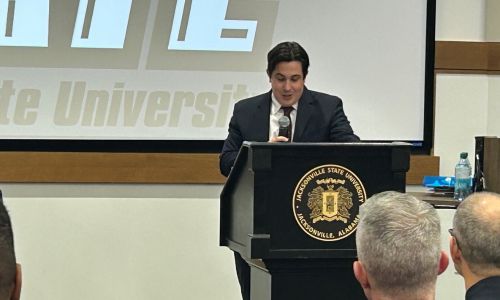
The ceremony opened with remarks from Kaleb Littlejohn, Executive Director of the Center for Best Practices in Law Enforcement, who thanked those who supported the inaugural class and the students who completed the program. Addressing the graduates, Littlejohn said, “I know that you will continue to be successful in both your professional and personal lives, and we hope that we will continue to be a part of that journey. But as you get those long administrative days that we’ve talked about, remember what a privilege it is to be tired from the hard work you went to the university for.”

Provost and Executive Vice President for Academic Affairs, Dr. Christie Shelton, then took the stage to welcome attendees and introduce the keynote speaker, Alabama Attorney General Steve Marshall. Dr. Shelton highlighted Marshall’s many accomplishments and his strong support of law enforcement, concluding, “His presence here today speaks to his continued commitment to strengthening law enforcement leadership and supporting those who serve.”
Attorney General Marshall, who also attended the program’s inaugural ribbon cutting, expressed his appreciation for being invited to speak to the first graduating class. He discussed the increasing complexities faced by today’s law enforcement leaders and how the SLCC program was designed to help navigate those challenges.

Marshall stated, “As local enforcement leaders in your own departments, your testing points are different from those you faced as young officers. Your courage will be tested when you make unpopular decisions for the right reasons. You’ll be tested when you must balance limited resources against unlimited needs. You’ll be tested when you have to hold your people accountable while supporting them through difficulty. And you’ll be tested when you must stand firm on principle, even when the pressure to compromise is intense.”
He continued by emphasizing servant leadership, saying, “The best leaders I’ve known share a common characteristic. They lead not from a position of authority or law, but from a foundation of service. They understand rank and title are tools for effectiveness, not symbols of superiority. They recognize that their decisions affect real people — the officers under their command, the families depending on those officers, and the communities trusting them to keep them safe.”
Marshall closed his remarks by telling the graduates, “From the bottom of my heart, I want you to know this: I believe in you, I am grateful for you, and I stand with you. God bless you all.”
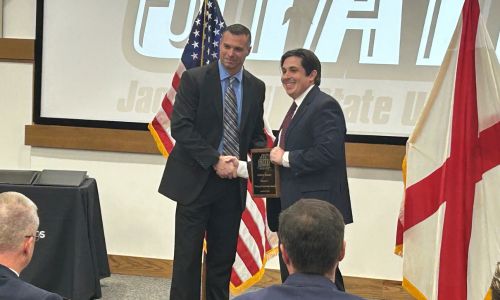
Littlejohn then returned to the podium to announce a class-voted award. The Emergent Leadership Award was presented to Lt. Andy Hunter of the Weaver Police Department. Littlejohn explained, “The Emergent Leadership Award is voted on by the class and is given to an individual who has emerged as a leader within the group — someone who has gone above and beyond in the program, taking on additional responsibilities and demonstrating leadership among their peers.”
Mr. Littlejohn then called Lt. Dusty Ford, Gadsden Police Department to present the Executive Directors award. He went on to explain that the award is decided by faculty and staff who vote for their choice.
The Calhoun Journal spoke with Lt. Hunter about his experience in the program. He said the training has been needed not only in the local area, but across the state for quite some time. He noted that in the past, promotions often relied more on tenure than on leadership training and education.
Lt. Hunter explained that the course was divided into week-long modules, with breaks between sessions. “This structure is beneficial to smaller agencies like mine,” he said. “We attend class for a week, then return to our department for a couple of months before the next module. Smaller agencies often have a more difficult time covering staffing gaps when an officer is away for extended periods.”
When asked about the biggest takeaway from the program, Lt. Hunter responded without hesitation: “The networking.” He explained that the structure of the course required participants to work together to solve problems and make decisions.
In closing, Lt. Hunter said, “This was an amazing experience, and I am deeply humbled that my fellow graduates voted for me to receive this award. I would highly recommend this course to every eligible law enforcement officer. I would also like to thank all of the instructors and JSU for making this program what it is.”
The inaugural graduating class consisted of 36 law enforcement officials ranging in rank from sergeant to chief of police. While participants came from across Alabama and included one from Georgia, Calhoun County was well represented. Officers from the Anniston Police Department, Calhoun County Sheriff’s Office, Oxford Police Department, JSU Police Department, Jacksonville Police Department, Weaver Police Department, and Ohatchee Police Department all completed the program and graduated.