
Montgomery, AL – Governor Kay Ivey on Wednesday signed Senate Bill 242, known as the Highway Safety and Fairness Act, into law, a measure aimed at strengthening safety standards for commercial motor vehicle operators across Alabama.
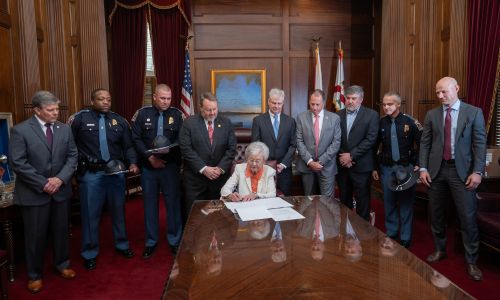
The bill signing took place in the governor’s office and was attended by state troopers, Alabama Law Enforcement Agency (ALEA) Secretary Hal Taylor, bill sponsors Sen. Lance Bell and Rep. Steve Clouse, as well as Alabama Trucking Association (ATA) President and CEO Mark Colson and members of the organization’s board.

The legislation establishes new requirements for commercial driver license (CDL) holders operating in Alabama, particularly those holding foreign CDLs. Under the law, drivers must possess valid U.S. work authorization and demonstrate English language proficiency. It also makes it a criminal offense to present a false foreign CDL during enforcement encounters.
Governor Ivey said the legislation is intended to balance economic growth with public safety.

“Alabama’s economy is booming, and our hardworking truckers play a vital role in keeping goods moving across our state and across this country. At the same time, Alabama families travel these same highways every single day, and they deserve to know the rules are being enforced,” Ivey said. “If you cannot read, write and speak English, you do not need to be driving a commercial vehicle on our roads.”
Sen. Lance Bell, the bill’s sponsor, said the measure is designed to enhance protections for motorists while supporting drivers who comply with regulations.
“The Highway Safety and Fairness Act is about protecting Alabama families and ensuring the integrity of our trucking industry,” Bell said. “By giving law enforcement additional tools to address fraudulent licenses, enforce existing federal standards and hold bad actors accountable, this legislation helps keep our highways safe while supporting the hardworking Alabama truckers who follow the rules every day.”
Rep. Steve Clouse, who carried the bill in the House, said the legislation promotes accountability within the state’s transportation system.
“The passage of the Highway Safety and Fairness Act helps ensure fairness, accountability and safety across Alabama’s transportation system,” Clouse said. “By establishing clear requirements for commercial drivers and meaningful penalties for those who violate the law, the Legislature has taken decisive action to protect the traveling public.”
The law builds on ongoing enforcement efforts by ALEA’s Motor Carrier Safety Unit, which conducts inspections and traffic stops involving commercial vehicles statewide. Since October 27, 2025, the unit has referred more than 555 individuals to U.S. Immigration and Customs Enforcement for immigration status verification. Of those, 221 individuals were detained based on their status.
In addition to immigration enforcement collaboration, ALEA troopers conduct federally mandated English Language Proficiency tests to ensure drivers can read road signs, understand safety instructions and communicate effectively during inspections or emergencies. Since January 1, 2025, the agency has issued 548 violations related to English language proficiency.
State officials say these efforts have coincided with improvements in roadway safety. In 2025, Alabama recorded 106 fatalities involving commercial motor vehicles, the lowest number since 2021. Data from ALEA also shows a 25 percent decrease in commercial motor vehicle-related fatalities when comparing the final quarter of 2024 to the same period in 2025, along with a 10 percent overall statewide decline year over year.
“Our law enforcement officers are already doing the good work to keep these unsafe drivers off Alabama’s highways,” Ivey said.
ALEA Secretary Hal Taylor said the legislation reinforces existing enforcement initiatives.
“Under Governor Ivey’s leadership, Alabama continues taking meaningful steps to strengthen highway safety and hold commercial drivers to the highest standards,” Taylor said. “This legislation reinforces the work our Motor Carrier Safety Unit is already doing to ensure drivers operating large commercial vehicles on our roads are properly qualified, legally authorized to work and able to communicate during inspections and emergencies.”
Mark Colson, president and CEO of the Alabama Trucking Association, said the measure will support both safety and fairness within the industry.
“Alabama’s law enforcement agency is a national leader in highway safety and SB242 will give them additional tools to keep illegal operators off the road,” Colson said. “This bill will save lives and help create a fair and level playing field in Alabama.”
Senate Bill 242 is scheduled to take effect on October 1, 2026.