

Calhoun County, AL – As temperatures continue to rise across Alabama, many households may notice an increase in their monthly electric bills. While rates often receive the most attention, energy experts say usage is frequently the primary factor behind seasonal increases in energy costs.
According to information provided by Alabama Power, Alabama residents use approximately 30% more electricity than the national average, largely due to the state’s hot summers, humidity and significant demand for air conditioning. Heating and cooling systems are typically the largest energy users in a home, accounting for an estimated 35% to 50% of monthly electricity consumption.

When temperatures climb into the upper 90s and beyond, HVAC systems must work harder and run longer to maintain indoor comfort. The larger the difference between the temperature outside and a home’s thermostat setting, the more energy the system generally requires to keep up.
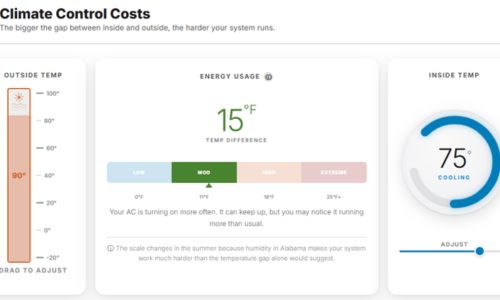
To help customers better understand that relationship, Alabama Power recently introduced an online tool called TempCheck. The tool allows users to select an outdoor temperature and an indoor thermostat setting to see how those differences affect overall energy demand.
After entering the temperatures, TempCheck provides an indication of whether energy demand would likely be considered low, moderate, high or extreme. The tool is designed to illustrate how weather conditions can impact electricity usage even when a homeowner does not change their thermostat setting.
For example, a thermostat set at 72 degrees may require significantly more energy on a 100-degree day than it would on an 85-degree day because the cooling system must work harder to overcome the larger temperature difference.
While the tool can help explain how weather affects energy demand, it is not a billing calculator and does not estimate actual electric bills. Factors such as the size and age of a home, insulation levels, the condition and efficiency of HVAC equipment, the quality of door and window seals, occupancy levels and individual comfort preferences can all influence energy usage. As a result, actual costs can vary considerably from one household to another.
The tool’s primary purpose is to help residents better understand why energy consumption often increases during periods of extreme heat or cold and why utility bills may rise even when rates remain unchanged.
Alabama Power notes that customer rates are currently frozen through 2027 under the Alabama Public Service Commission framework. However, higher temperatures can still result in increased electricity usage, and increased usage can lead to higher monthly bills.
For residents looking to reduce energy consumption while remaining comfortable during the summer months, experts recommend several practical steps:
- Set the thermostat a few degrees higher when away from home.
- Use ceiling fans to improve comfort and air circulation, and turn them off when rooms are unoccupied.
- Keep blinds and curtains closed during the hottest part of the day.
- Avoid using ovens, dryers and other heat-producing appliances during peak afternoon hours when possible.
- Replace or clean HVAC air filters regularly to improve airflow and efficiency.
Several free tools are also available to help customers better understand and manage their household energy use throughout the year.
Resources Available
My Power Usage – Track daily and monthly energy consumption.
https://www.alabamapower.com/residential/save-money-and-energy/energy-saving-programs/my-power-usage.html
Budget Billing – Helps smooth seasonal spikes by averaging energy costs throughout the year.
https://www.alabamapower.com/residential/billing-and-payment-options/budget-billing.html
Home Energy Reports – Provides personalized energy-efficiency recommendations.
https://ehers-enrollment.alabamapowerprograms.com [ehers-enrollment.alabamapowerprograms.com]
Bill Explainer – Helps customers understand charges appearing on monthly bills.
https://www.alabamapower.com/residential/billing-and-payment-options/understand-my-bill.html
Rate Advisor – Compares available rate plans to determine which may be most beneficial for a household.
https://www.alabamapower.com/residential/residential-pricing-and-rate-plans/discover-your-rate-plan.html
Energy Assistant – Provides information on available bill-payment assistance programs.
https://www.alabamapower.com/residential/billing-and-payment-options/payment-assistance-programs/energy-assistant.html
Summer Energy Savings Resources – Additional tips and tools for reducing energy use during hot weather.
https://www.alabamapower.com/residential/save-money-and-energy/save-this-summer.html
With summer temperatures expected to remain high across much of Alabama, understanding how weather impacts household energy usage can help residents make informed decisions about comfort, conservation and managing seasonal utility costs.